

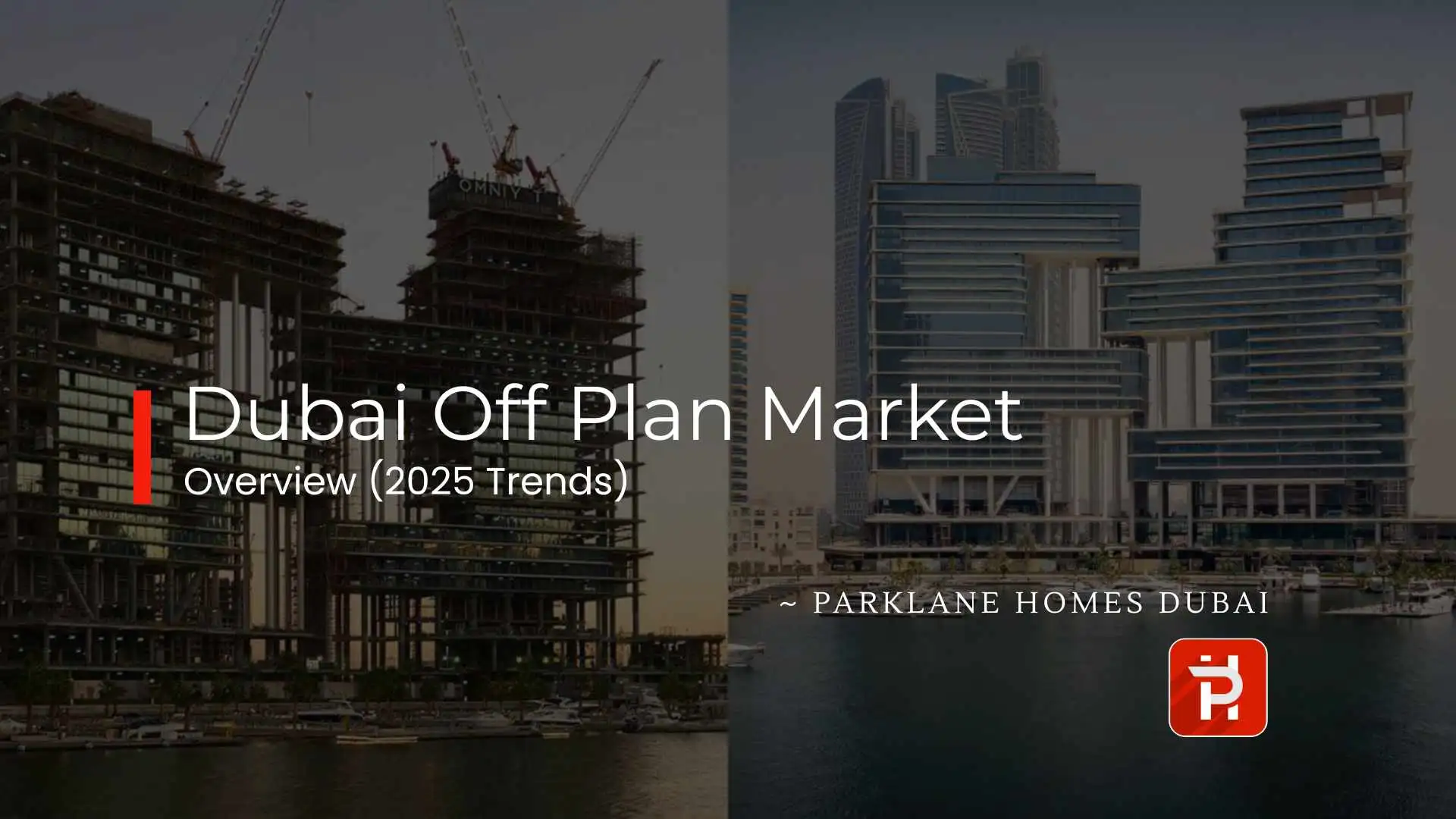
Dubai Off Plan Market Overview (2025 Trends)
Dubai’s off-plan property market has moved well past the point of being called a trend. In Q1 2026, off-plan transactions accounted for 72.1% of all residential deals, representing AED 103.4 billion in value across 32,608 transactions, according to data published by Sherwoods Property and corroborated by Cavendish Maxwell. This is not a market driven by hype. It is a market supported by regulatory infrastructure, genuine population growth, and a supply pipeline that continues to attract capital from over 100 nationalities.
This guide is written for buyers who want more than a list of communities. It covers the mechanics of how payment plans actually work, how to read developer risk, what the data says about different buyer profiles, and where the genuine opportunities and traps lie in 2026.
What Off-Plan Actually Means: The Legal and Financial Mechanics

An off-plan property is one sold before construction is complete, sometimes before a single floor has been poured. The buyer commits to a purchase price based on approved architectural plans, a registered Sales and Purchase Agreement (SPA), and a developer-registered project with the Real Estate Regulatory Authority (RERA).
What separates Dubai from many other off-plan markets globally is its escrow architecture. Under Law No. 8 of 2007, all buyer payments must flow into a RERA-registered project-specific escrow account managed by an independent bank. The developer cannot draw from that account freely.
Withdrawals are triggered only when a RERA-certified engineer confirms a construction milestone has been completed. This means your money is not sitting in a developer’s operating account. It is sitting in a regulated fund that releases in stages tied to physical progress.
Before any transaction, buyers should verify three things on the Dubai Land Department portal: that the project is registered with RERA, that the developer holds an active developer license, and that the specific unit is registered under Oqood (the off-plan registry). Oqood registration within 60 days of signing the SPA is a legal requirement, and it is your formal proof of ownership during the construction period.
2026 Market Data: What the Numbers Actually Tell You
The headline figure from Q1 2026 is AED 176.7 billion in total residential sales across 47,996 transactions, a 23.4% increase in value and 5.5% increase in volume year-on-year, per fam Properties and Gulf News. January 2026 alone set the all-time monthly record for Dubai real estate at AED 72.4 billion, driven primarily by a 90% surge in primary market activity.
Within that, off-plan’s dominance is structural, not cyclical. Over the past three years, off-plan transaction volumes have grown 80.4%, from 18,071 units in Q1 2023 to 32,608 in Q1 2026. Ready property volumes, by comparison, grew 9.8% over the same period and have remained broadly flat in the 11,000 to 15,000 unit range per quarter. The divergence is not temporary.
On pricing, the average price per square foot across Dubai reached AED 1,759 in Q1 2026, up 12.5% year-on-year. Off-plan apartments averaged AED 2,100 per square foot. Villa median prices in the primary market climbed 35.3% year-on-year to AED 4.1 million. This villa premium reflects a structural supply constraint: freehold land for new villa communities is finite, while apartment supply continues to enter at scale.
The forward pipeline reinforces confidence. Across the four-year delivery window from 2026 to 2029, Dubai developers have 426,182 units scheduled for completion. Of those, 304,493 are already sold, a blended absorption rate of 71.45%, according to fam Properties citing DXBinteract data.
For 2026 alone, 10 major developers are scheduled to deliver 43,217 units, of which 41,015 are already sold, a 94.91% absorption rate. In the context of global real estate, where London sold 8,436 new homes in the entirety of 2025, this level of forward demand is extraordinary.
However, Q1 2026 also showed transaction volumes declining 17.1% from Q4 2025’s record highs, reflecting what Savills described as a shift from a sellers’ market to a buyers’ market. This is not a contraction. It is maturation. Buyers are now making more deliberate, value-driven decisions rather than buying anything available at launch. For informed buyers, this is an advantage.
Payment Plans: How They Work and What Each Structure Means for You
Payment plans are the single most consequential financial decision in any off-plan purchase. Yet most guides list them as a bullet point. The structure you choose shapes your cash flow, your risk exposure, your financing options at handover, and ultimately your return profile.
The Main Payment Plan Structures in 2026
Construction-linked milestone plans are the baseline. These split the purchase price into three phases: a booking deposit (typically 10 to 20%), staged installments tied to construction milestones during the build period, and a balloon payment at handover. The split is usually expressed as 60/40, 70/30, or 80/20, referring to how much is paid before handover versus at handover.
A 60/40 plan means you pay 60% during construction (usually over 2 to 4 years, linked to milestones like foundation, structure, and finishing) and 40% at handover. A 70/30 plan front-loads more of the payment during construction and reduces the final balloon. An 80/20 plan is the most construction-heavy, requiring only a 20% final payment.
The choice between these depends entirely on whether you want to minimize capital deployed upfront or minimize the payment due at the point you need to refinance, sell, or take possession.
Post-handover payment plans (PHPPs) are a separate category. Under a PHPP, a portion of the total price is deferred beyond the completion date. A common structure is 50/50 over 2 to 3 years, where half is paid during construction and half in equal installments after you receive the keys. More generous versions carry 30 to 50% into a 3 to 5 year post-handover period. Unlike a mortgage, PHPPs carry no interest on the deferred balance. The total price is fixed at purchase.
The practical advantage of a PHPP for investors is that you can begin generating rental income immediately after handover and use that income to service the remaining installments. For end-users, it means you can move in and pay from your salary rather than needing the full purchase price at completion. The trade-off is that developers typically price this convenience into the unit cost.
The 1% monthly model is a newer structure gaining traction among mid-market developers. After a down payment of 10 to 20%, buyers pay 1% of the purchase price every month, either during construction or extending post-handover. On a AED 1.5 million unit, that is AED 15,000 per month. For buyers with predictable monthly cash flow, this removes the lumpy milestone payment uncertainty.
Time-based plans operate on calendar dates rather than construction milestones. Payments fall every four or six months regardless of where the building stands. These are less common because they decouple payment from physical progress, which can disadvantage buyers if construction slows.
What to Actually Negotiate
Most buyers treat payment plan terms as fixed. They are not. Based on current 2026 market conditions, where the market has shifted toward buyers having more leverage than in 2022 and 2023, there are genuine negotiating opportunities. Developers holding unsold inventory in a project that is 70 to 80% sold are often willing to extend post-handover periods rather than cut the headline price.
Buying toward the end of a launch phase, rather than on day one, gives you stronger negotiating position. Buying two or more units from the same developer gives substantial leverage on both pricing and plan terms. Summer months, specifically June through September, typically see lower transaction volumes, and developers maintaining sales targets may offer better structures during these quieter periods.
Understanding the Risks: What You Are Actually Signing Up For
Off-plan investing carries real risks that deserve direct treatment rather than a four-bullet disclaimer.
Construction Delay Risk
Dubai’s RERA framework provides legal recourse when property developers miss delivery dates. Under the SPA, buyers are entitled to compensation for delays beyond the agreed handover date. However, legal proceedings against developers are time-consuming and, in many cases, buyers accept amended handover dates rather than pursue litigation.
The practical protection is choosing developers with verifiable delivery records. Emaar, for example, sold 99.1% of its 9,085 units scheduled for 2026 delivery, reflecting a track record that sustains buyer confidence. Before committing to any developer, check their DLD project completion history, not their marketing material.
Oversupply Risk in Specific Segments
The 2026 delivery pipeline is approximately 72,000 units planned across Dubai. Knight Frank estimates actual completions at roughly 46% of planned supply, equating to around 33,000 to 34,000 real handovers. Even at that level, certain community types face absorption pressure. Mid-market apartments in supply-heavy corridors face more competition for tenants and resale buyers than villas in established communities or apartments in prime zones with genuinely constrained land. Location selection in 2026 requires granular analysis, not just broad area names.
Resale Liquidity Risk
Many buyers plan to sell near completion rather than hold through handover. This strategy, often called flipping, carries meaningful risk in a market where buyer preferences have shifted toward more selective, value-driven decisions. The off-plan secondary segment saw a 9% decline in values and a 27% drop in volumes in January 2026 compared to the same period in 2025, per Property Finder data. This does not mean resale is impossible. It means that the automatic appreciation assumption that worked in 2021 and 2022 requires more careful underwriting today.
Developer Insolvency Risk
RERA’s escrow system significantly reduces but does not eliminate this risk. If a developer ceases operations, RERA has the authority to appoint a replacement developer or return funds to buyers from the escrow account. Buyers should review the SPA carefully for clauses governing what happens in insolvency scenarios and verify that the project’s escrow account is registered and active on the DLD portal before paying any funds.
Quality and Specification Changes
SPAs allow developers a margin of variance in specifications and unit dimensions (typically 5% on area). Show unit finishes are aspirational, not contractual. Before signing, establish in writing which specifications are contractually binding. After receiving your keys, conduct a professional snagging inspection (typically AED 1,500 to AED 3,000) before formally accepting handover. Snagging can identify defects worth significantly more than the inspection cost in remediation.
Buying Strategy by Investor Profile
The original article treats all buyers as interchangeable. They are not. Your optimal strategy depends fundamentally on your objective, your financing situation, and your tax and residency context.
UAE Resident Buyers Financing with a Mortgage
UAE banks lend up to 80% loan-to-value on properties below AED 5 million for UAE residents. Your debt burden ratio, meaning total monthly debt obligations including the proposed mortgage, cannot exceed 50% of gross monthly income. Fixed mortgage rates in 2025 and 2026 have ranged from 3.99% to 5.5% depending on lender and income profile, supported by EIBOR cooling from 4.0% to 3.5%.
For financed buyers, the standard strategy is to pay construction-phase installments from savings or income, then refinance the remaining balance at handover with a bank mortgage. This converts the deferred handover payment into a long-term loan rather than requiring a large lump sum.
Non-Resident Investors
Non-residents face a maximum loan-to-value of 50% from UAE banks, which means a 50% down payment plus 6.5 to 7% in acquisition costs (4% DLD transfer fee, 2% agency commission, and conveyance fees). On a AED 2 million apartment, total upfront capital requirement for a mortgaged non-resident is approximately AED 1.13 million.
Many non-residents therefore prefer post-handover payment plan structures that spread the total cost over a longer period without requiring bank financing at all. The zero capital gains tax environment and absence of income tax on rental returns are the primary structural drivers of overseas investor demand.
Investors Targeting Rental Yield
Gross rental yields in Dubai in 2026 range from 5% to 9% depending on community and property type. Affordable areas including JVC and Dubai South deliver 7% to 9% gross. Premium areas including Palm Jumeirah and Downtown Dubai range from 4% to 6%. Net yields after service charges and property management fees typically run 1.5 to 2% below gross.
The strongest yield play in 2026 for off-plan buyers is targeting communities with limited ready supply, high rental demand from working professionals, and handover timelines of 18 to 24 months. JVC, JLT, and Business Bay apartments in the AED 1 to 2 million range are regularly cited by advisors for this profile.
End-Users Buying to Live
For end-users, the primary advantage of off-plan is buying at today’s price in a community that will likely command a premium in two to four years. The risk is lifestyle disruption from delays. End-users should prioritize developers with strong delivery records, avoid projects with handover dates that leave them in rental limbo for more than six months beyond stated delivery, and budget for fit-out, furnishing, and service charges from day one. Service charges for apartments in Dubai typically range from AED 10 to AED 25 per square foot annually.
Where the Demand Is in 2026: Communities with Real Context
Community selection in 2026 requires understanding why demand exists in a location, not just that it does.
- Business Bay: Central location with proven rental demand from corporate professionals. Q1 2026 data from Sherwoods shows 1.90% quarterly price growth. One-bedroom apartments remain the most liquid unit type. The segment is supply-intensive, so unit quality and floor level matter significantly for resale and rental.
- Dubai Hills Estate: Villa prices appreciated sharply, with median values climbing in line with broader villa premium trends. Golf course proximity and school access drive genuine end-user demand. Emaar-branded projects here benefit from resale liquidity due to brand recognition.
- Dubai Creek Harbour: One of the larger master-planned communities with long-term infrastructure buildout. Buyers here are buying into a vision rather than an established neighborhood. Suitable for patient capital with a 5 to 7 year horizon.
- Jumeirah Village Circle (JVC): The highest rental yield zone in Dubai for apartments. Sustained by a large tenant base of mid-income professionals. Supply is substantial, which caps capital appreciation but supports occupancy rates.
- The Oasis by Emaar: The single largest off-plan transaction location in Q1 2026 at AED 9.71 billion. Ultra-luxury villa community appealing to UHNWI buyers. Not a yield play. A capital preservation and lifestyle acquisition.
- Emirates Hills: 11.33% villa appreciation in Q1 2026 per Sherwoods data. Established, supply-constrained. Primarily a secondary market play rather than off-plan.
- Dubai South: Benefits from Expo City expansion and proximity to Al Maktoum International Airport. Off-plan prices remain accessible. Long-term infrastructure story with patient capital requirement.
How to Verify Before You Commit: The Practical Due Diligence Checklist
Generic advice to ‘research the developer’ is not actionable. Here is what that actually means in practice in 2026.
Model the handover scenario realistically: If using a mortgage, confirm with a bank pre-approval before committing. If using a PHPP, stress-test the installment schedule against a scenario where rental income is 20% lower than projected for the first year.
Check DLD project registration: Go to the Dubai Land Department portal and confirm the project holds an active registration number. Unregistered projects have no legal standing.
Verify escrow account status: Confirm the project-specific escrow account is registered and active. The escrow bank should be named in the SPA. You can verify this on the RERA Escrow portal.
Review the developer’s delivery history: Request a list of completed projects with their contracted and actual handover dates. Developers with a pattern of delays exceeding 12 months warrant additional scrutiny regardless of current project reputation.
Read the SPA before signing: Pay specific attention to the force majeure clauses (which can excuse delays), the specification variance allowances (typically 5% on area), the cancellation policy and refund schedule, and what constitutes a breach by either party.
Check Oqood registration: After signing, your unit should be registered in Oqood within 60 days. Failure to register is a legal violation. You can verify your Oqood registration on the DLD website.
Budget acquisition costs accurately: Total acquisition costs are 4% DLD transfer fee, 2% agency commission, and conveyance fees, amounting to roughly 6.5 to 7% of purchase price. These are due at signing, not at handover.
The 2026 Market Context: What Has Changed From Previous Years
Buyers entering in 2026 are entering a different market than buyers who entered in 2021 or 2022. The key differences matter for strategy.
The market has shifted from seller-dominated to buyer-influenced. The 17% decline in transaction volumes from Q4 2025 to Q1 2026 reflects cooling from record highs, not contraction. Savills described it as Dubai entering a buyers’ phase. This means negotiating on price and terms is more viable today than it was 18 months ago.
New investor participation is rising. Q1 2026 saw 29,312 first-time market entrants, a 14% increase year-on-year, per D and B Properties data. This broadening of the buyer base across nationalities is a structural positive for market liquidity.
The luxury segment continues to diverge from mid-market. A single AED 422 million apartment and an AED 350 million villa transacted in Q1 2026. Ultra-prime areas including Palm Jumeirah and Dubai Hills have experienced 15 to 30% annual appreciation. The mid-market, where new supply is heaviest, requires more selective community and unit type choices to generate comparable returns.
Population growth is the underlying demand driver that distinguishes Dubai from speculative cycles in other markets. Dubai welcomed approximately 1,000 new residents per day through 2025 and into 2026. The emirate’s population crossed 3.7 million in early 2026 and is forecast to reach 5.8 million by 2040. Each new resident creates rental demand. That demand has no substitute other than new housing stock, and new housing stock takes years to deliver.
Parklane Homes: Your Partner in Dubai Off-Plan Investments
Navigating the Dubai property market is exciting, but it can also feel overwhelming. That’s where Parklane Homes comes in. Our team specializes in connecting buyers with trusted developers and high-performing projects across the city.
We don’t just help you find a property; we help you understand the market, compare payment plans, and choose developments that match your financial goals. Whether you’re a first-time buyer or a seasoned investor, Parklane Homes provides transparent advice, updated listings, and personalized guidance.
Conclusion: Off-Plan in 2026 is a Strategy, Not a Shortcut
The data is clear. Off plan dominates Dubai’s residential market not because of developer marketing but because the regulatory framework is sound, the payment mechanics are genuinely flexible, and the underlying population growth creates durable demand for the housing being built.
What has changed in 2026 is the precision required to execute well. The market that lifted almost every purchase in 2021 and 2022 now rewards buyers who understand payment plan mechanics, developer risk, community-level supply dynamics, and the specific requirements of their own buyer profile.
The buyers who will look back on 2026 as a strong entry point are the ones who treated it as a strategy. They verified developer track records. They modeled handover scenarios conservatively. They matched payment plan structures to their actual cash flow. And they chose communities where demand fundamentals are supported by infrastructure, population access, and constrained supply.
That is not a complicated approach. It is simply a disciplined one.
Key Data Sources
fam Properties Q1 2026 Market Report | Cavendish Maxwell Q1 2026 Residential Report | Sherwoods Property Q1 2026 Analysis | Property Finder January 2026 Data | DXBinteract Pipeline Data | Gulf News Q1 2026 Property Sales Coverage | Savills Middle East Q1 2026 Residential Report | D and B Properties Q1 2026 Market Report | Dubai Land Department Official Records


